

Table of Contents
- Start With the Story You Want to Wear
- How to Write a Hunting Story for Custom Apparel
- Tools for Creating Custom Clothing Graphics
- Storytelling Apparel Design Tips That Actually Work
- Choosing Garment Types and Print Methods
- File Preparation, Copyright, and Fulfillment
- Conclusion
- Frequently Asked Questions
Last Updated: October 4, 2026
Start With the Story You Want to Wear
The best custom apparel design starts with one question: what's the story? At O'MEA™, people don't want a random graphic. They want the fish that got away, the buck that kept running, the putt that lipped out on 18. Designing custom apparel for stories means treating the memory as the brief, not the graphic.
Why Personal Stories Make the Best Apparel Designs
A design built around a real moment carries details a stock graphic never will: the weather, the bad call, your buddy's reaction. Those specifics make people ask, "What happened there?" Generic shirts get a nod; story shirts get a conversation.
How to Write a Hunting Story for Custom Apparel
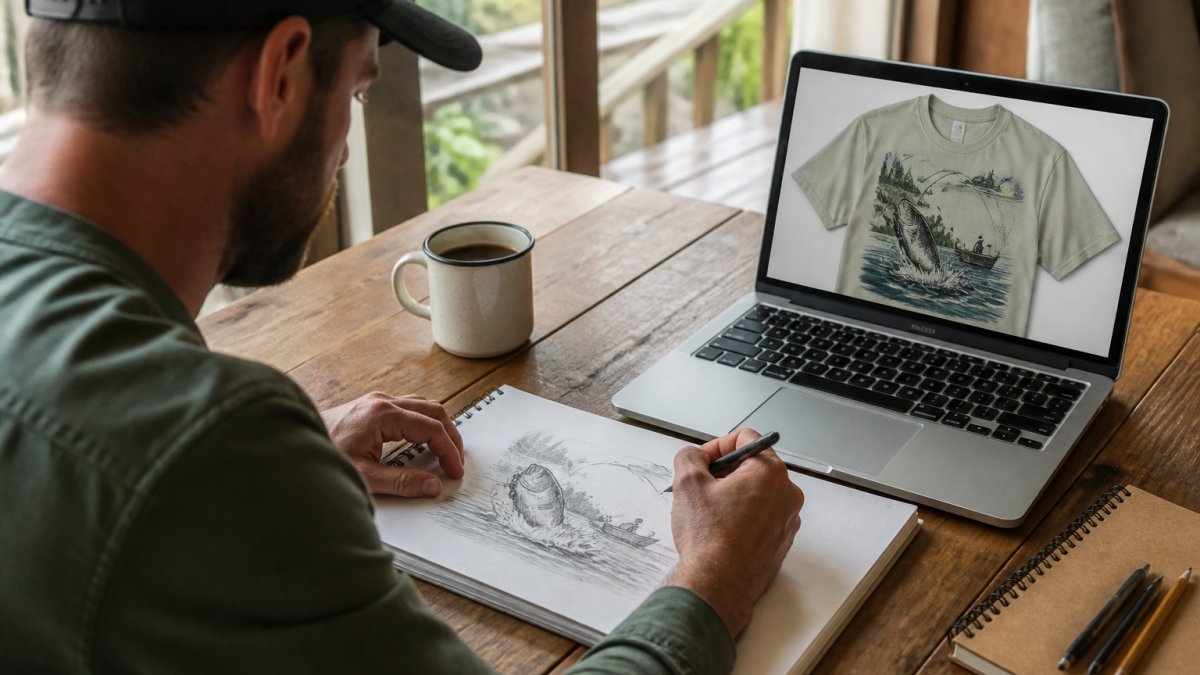
Writing a hunting story for custom apparel means shrinking the tale to its sharpest moment, a caption that lands in one read, not an essay. Start with the turn: the moment it all slipped away. Build the design around that beat.

Turning a 30-Second Anecdote Into a Design Brief
Here's a framework to turn a rambling story into a wearable design.
- The setup: Where were you, and what were you after?
- The turn: What went wrong at the worst possible time?
- The punchline: What do you still say about it?
That tagline becomes your back print. Everything else becomes the scene.
Ask: if a stranger reads this shirt for five seconds, do they get the joke? If not, cut words.
Tools for Creating Custom Clothing Graphics
You don't need professional software to make a shirt. Most people start with free design tools and a mockup generator. Here's what each type does:
| Tool Type | Best For | Skill Level | Cost |
|---|---|---|---|
| Design templates | Fast starts | Beginner | Free |
| Graphic design software | Full control | Intermediate | Varies |
| Mockup generators | Previewing on a garment | Beginner | Free |
| Vector editors | Clean logos and text | Intermediate | Varies |
Pick based on how much control you want. Templates save time, but custom scenes need more room. If you'd rather skip the software, O'MEA™ handles the design work, you bring the story, we build the scene.
Storytelling Apparel Design Tips That Actually Work
The strongest storytelling apparel design tips point to one idea: clarity beats cleverness. A design nobody can read at a glance fails, however good the art.
Balancing Text and Graphics on Your Garment
Text and graphics fight for space. Give each one a job.
- Text carries the punchline. Keep it short and bold.
- Graphics set the scene. Show the moment, not the whole day.
- White space gives both room to breathe. Cluttered shirts read as noise.
A common mistake is cramming the full story onto the back. Pick one moment and let the shirt hint at the rest. High-contrast text on a busy scene disappears, so solid backgrounds keep small text readable.
Choosing Garment Types and Print Methods
Garment choice and print method decide how your design looks on fabric, how it feels, and how long it survives washing. Get this right and your story outlasts the memory behind it.
Screen Printing vs. Direct-to-Garment (DTG)
Direct-to-garment printing sprays ink straight onto the fabric like a high-end inkjet printer. It handles photographic detail, gradients, and unlimited colors without per-color setup, making it right for one-off designs and detailed scenes.
For story shirts, DTG usually wins, every design is different, and detailed scenes need that flexibility. Screen printing shines for bulk orders of the same design: team shirts, event merch, or a proven seller.
| Method | Best For | Setup Cost | Durability | Color Range |
|---|---|---|---|---|
| Screen print | Bulk runs, 1-4 color designs | High per design | Excellent | Limited by screens |
| DTG | One-offs, photos, gradients | None | Good | Unlimited |
| Heat transfer / DTF | Small batches, full-color | Low | Good | Unlimited |
| Embroidery | Logos, left-chest marks | Medium (digitizing) | Excellent | Thread colors only |
Matching the Garment to the Design
Garment quality matters as much as the print method. A heavier cotton tee holds print better and lasts longer than a thin one, but weight isn't the only variable.
- Fabric weight: Measured in ounces per square yard. A 4.0-4.5 oz tee is light and drapey; 5.5-6.0 oz is a midweight workhorse; 6.5 oz and up is heavy and structured. Heavier fabric resists show-through and holds a large back print without stretching the artwork.
- Fiber content: 100% cotton takes DTG and screen print well and feels soft, but can shrink. Cotton/poly blends resist shrinking and wrinkling and are popular for DTG because the poly helps the ink bond. Tri-blends (cotton/poly/rayon) are soft and drape well but can print slightly muted.
- Color: Dark garments require a white underbase for DTG, adding cost and a thicker hand feel. Light garments print more vibrantly and cheaply. If your story scene is detailed and colorful, a light or heather garment usually shows it best.
O'MEA™ prints on Gildan and Bella+Canvas blanks, classic tees, long sleeves, and hoodies.
O’MEA™ Almost Married — Classic Tee →
A Quick Decision Path
If you're unsure where to start, run the design through this order:
- How many colors and how much detail? Many colors and photographic detail point to DTG.
- How many units? One to a handful points to DTG.
- Where does it sit on the garment? Full back and full front point to DTG.
- What is the garment? Heavy cotton for a structured look, blends for softness and shrink resistance, tri-blend for drape.
Answer those and the method picks itself.
File Preparation, Copyright, and Fulfillment
Clean files prevent ugly surprises. Most print problems trace back to low-resolution artwork or a color mismatch, not the printer.
File Specs That Print Correctly the First Time
Every print method has a target file spec. Submitting the wrong one is the most common reason a story shirt comes back blurry, faded, or off-color.
- Resolution: Raster artwork should be 300 DPI at the final print size, not screen size. A 12-inch-wide back print needs a source image at least 3,600 pixels wide. Scaling a 1,000-pixel image to 12 inches drops you to roughly 83 DPI, which prints soft.
- Vector vs. raster: Vector files (AI, EPS, SVG, PDF) stay sharp at any size and suit logos, taglines, and text. Raster files (JPG, PNG, TIFF) are for photographic scenes and detailed illustrations. If your design mixes both, keep the text as vector and place the raster scene behind it.
- Color profile: Convert to CMYK before submitting. Monitors display in RGB, a wider, brighter gamut, so a neon green that looks electric on screen prints duller in CMYK. If your design depends on a specific brand color, ask for a Pantone match rather than trusting the preview.
Copyright and Trademark: What You Can and Cannot Print
This is the gap most guides skip, and it can cost you the most. Custom apparel sits squarely in the crosshairs of copyright and trademark law.
- Copyright protects original creative works, artwork, photographs, song lyrics, book passages, movie quotes, and characters. You cannot print a copyrighted character, a band's album art, or a line of lyrics without a license, even if you redraw it in a different style. Redrawing does not erase the underlying copyright.
- Trademark protects brand identifiers, team names and logos, company names, slogans, and mascots. Printing a professional or college team logo on a shirt for sale is trademark infringement, and enforcement is aggressive. Even a parody close enough to cause confusion can draw a cease-and-desist.
- What is safe: Your own story, photographs, original artwork, and non-trademarked phrases. Generic phrases like "Opening Day" or "Missed the Shot" are generally fine. A specific team's rally cry is not.
- Public figures and likeness: Using a real person's name or likeness on merchandise can trigger right-of-publicity issues, which vary by state. When in doubt, leave it out.
Beginners often assume personal use means no license is needed. Personal use is not a blanket defense, especially if the item is sold, given away publicly, or posted for sale online. If you plan to sell, assume you need written permission for anything you did not create.
U.S. Copyright Office, fair use and registration basics
Fulfillment Logistics Most Guides Stop Short Of
Design is half the job. Getting the finished shirt to the right person on time is the other half, and where made-to-order apparel differs from off-the-shelf retail.
- Made-to-order timing: Print-on-demand and custom-scene production means your item is printed after you order, not pulled from a shelf. Build in production time plus shipping time. For gifts and holidays, order well ahead of the date you need it.
- Packaging: A story shirt is a keepsake, not a commodity. Poly mailers are cheap and light; rigid mailers or boxes protect folded prints and feel more premium. Include a care card, wash inside out, cold water, tumble low or hang dry, because heat cracks and fades prints over time.
- Inventory decisions: If you are selling, decide early between made-to-order (no upfront inventory, longer lead times, higher per-unit cost) and bulk production (lower per-unit cost, but you carry unsold stock and pay for storage). Made-to-order suits unpredictable demand; bulk suits proven sellers.
- Returns and sizing: Made-to-order shirts generally cannot be returned for buyer's remorse or the wrong size, only for defects. That makes the size chart a conversion tool, not fine print. Put it where buyers actually see it.
That $5 custom scene fee at O'MEA™ keeps your design exclusive. It never enters our public catalog, so nobody else can order your story.
Conclusion
Turning a near-miss into a shirt takes one good story and a clean file. The hard part isn't the design software. It's picking the moment worth wearing.
That's where we come in. O'MEA™ builds your custom scene for a one-time $5 fee, prints it on quality tees, long sleeves, and hoodies, and keeps your design exclusive to you.
Ready to wear your best excuse? Shop the designs and turn that almost into something you'll actually want to show off.
Frequently Asked Questions
How do I turn a personal story into a clothing design?
Start by writing the story in plain language, then circle the one image or punchline that captures it. For example, a fishing near-miss becomes a silhouette of a leaping bass with the caption 'The one that got away.' Sketch it or describe it to a designer, choose a garment type, and pick DTG for detailed artwork. The goal is one clear visual moment, not the whole story.
What file formats are best for custom apparel printing?
For direct-to-garment printing, vector files (AI, EPS, SVG) are ideal because they scale without losing quality. If you only have a raster image, use a PNG at 300 DPI or higher at the final print size. Avoid JPEGs for artwork with text or sharp edges, since compression creates blurry outlines. Always check that your color profile is set to CMYK before submitting to a printer.
Can I use personal anecdotes for custom apparel designs?
Yes, and they often make the most memorable garments. A personal anecdote gives you built-in specificity: names, places, and details that generic designs lack. Just avoid using copyrighted logos, trademarked phrases, or another person's likeness without permission. If your story involves a real brand (like a boat manufacturer or a sports team), describe it generically or leave it out to stay clear of trademark issues.
What are the best tools for creating custom clothing graphics?
Free options like Canva and Inkscape work well for simple text-and-graphic layouts. Adobe Illustrator gives you full vector control for complex designs. If you are not a designer, many print-on-demand services offer a mockup generator and templates that let you upload artwork and see it on a garment before ordering. O'MEA™, for instance, offers custom scene creation for a one-time $5 fee, which keeps your design exclusive and off their public catalog.
Leave a comment